
Homesteads
“Wheatland” by jimbowen0306 is licensed under CC BY 2.0.
Exploring these homesteads is an opportunity to see how Lancaster grew from families of hopeful colonials, to a community with a love for art, agriculture, and architecture.

JAMES BUCHANAN'S WHEATLAND
James Buchanan’s Wheatland

AMOS HERR HOUSE
Amos Herr House
The iconic red-trimmed roof of this house sits atop white brick walls, erected as early as 1852, by one of Hans Herr’s descendants, Amos. Standing proudly aside is a magnolia tree, which blooms with majestic pink blossoms each spring. The home and its surrounding rose bushes sit at the back of a long lane of other trees, granting a quaint and quiet atmosphere visitors can sense once they reach the top of the hill. However, much of the initial property was granted to the township and is now used as a park, under the same name, and makes for an excellent pit stop on your journey

JOHANNES MUELLER HOUSE
Johannes Mueller House
It might be easy to walk past the Johannes Mueller House without realizing its historic significance. The two-part building (half stone, half white siding) sits nestled among the other homes in Lititz as a model of the 18th century. It originally served as a home for the Muellers and their employees who crafted leather dyes. The building has undergone restoration, losing its initial log walls for the new siding in one of several changes, but tours still offer a look at wooden leatherwork tools, worn dark from age and used by many generations of hands.

ROBERT FULTON BIRTHPLACE
Robert Fulton Birthplace
Robert Fulton was a late 18th / early 19th-century inventor born in this very home in 1765. He was most known for his work on steamboats, including the Clermont, which successfully sailed the Hudson River in 1807. Fulton also dabbled in painting, traveling all the way to Europe to study up on the craft. But here in the states, his place of birth was a small, square homemade of multicolored stone that still sits peacefully in Lancaster County farmland. A small creek runs quietly nearby, embraced by trees. The atmosphere is one of comfortable nostalgia, a picture of possible memories in the countryside.

LANDIS VALLEY FARMS
Landis Valley Farms
It’s not every day you find a museum building nearly as old as the history within it. T he Landis Valley Museum’s asymmetrical brick structure looks just like a home, but in reality, it houses a collection of antiques from German settlers. T he Landis brothers, George and Henry, collected these artifacts and established the museum in the 1920s. Walking down the roads here will feel like a step into history, as the grounds hold several other historic buildings of wood, stone, and brick, most of which date back to at least the 19th century.

WRIGHT'S FERRY MANSION
Wright’s Ferry Mansion
When you think of a mansion, you likely won’t picture a quaint, two-story home made of weathered stone and covered in ivy. But that’s just what you will find at Wright’s Ferry Mansion. The building was constructed in 1738 for a Quaker, Susanna Wright, and still holds an air of antique wonder within its halls. The narrow windows and wooden floors are a testament to another time. It’s easy to imagine its original occupant and literary genius, Susanna, sitting at the fireplace while penning a poem or letter to Benjamin Franklin. If not that, she would certainly be deep within the pages of one of her many books.

HANS HERR HOUSE
Hans Herr House
History speaks loudly in the way a home is built, and the Hans Herr House speaks its age through its stones. Built-in 1719, it is the oldest standing home in Lancaster County. But this ancient homestead can tell you as much with a single look. The walls are mixed with stones of all sizes and colors, separated by streams of mortar that have no need for tidiness. And the windows are silently guarded by exterior wood shutters, gone gray with time, but still hold fast like the Mennonite descents of the Herr family, who are still prevalent in Lancaster County today.

EPHRATA CLOISTER
Ephrata Cloister
The Ephrata Cloister feels like you’re stepping into another era. This historic 1700s settlement boasts multiple buildings made of time-worn timber and stone foundations. Once a respite for religious families leading humble lives in preparation for the afterlife, the lush green lawns, and surrounding woods were likely an excellent place for peaceful seclusion, just as they seem to be even now. With admission, visitors can explore the grounds at their own pace, or experience a guided tour for a closer look at a simpler life.

GENERAL EDWARD HAND MANSION
General Edward Hand Mansion
Inside Lancaster County Central Park, Rock Ford may not initially show its late 18th century roots, but the proud brick façade houses a collection of history and art from the era. If you take a moment to breathe the fresh air and feel the grass under your 1719, it is the oldest standing home in Lancaster County. But this ancient homestead can tell you as much with a single look. feet, you can imagine standing on an estate of old. The household also has a military background, dating as far back as General Edward Hand, an Adjutant of General Washington. But Hand’s passion wasn’t only for war. He also had a knack for gardening and introduced his own strain of plums during his life at Rock Ford.

Spotlight
What are the most historic homesteads in Lancaster County?
What architectural styles can be found in Lancaster’s historic homesteads?
What is the oldest house in Lancaster County?
Are historic homes in Lancaster County open to the public?
Celebrate the rich architectural and cultural legacy of Pennsylvania Dutch Country with our Historic Homesteads of Lancaster County poster. This 12×18″ illustrated art print features nine of the region’s most iconic homes, each representing a piece of Lancaster’s early American story — from colonial stone farmhouses to preserved Federal-style mansions.
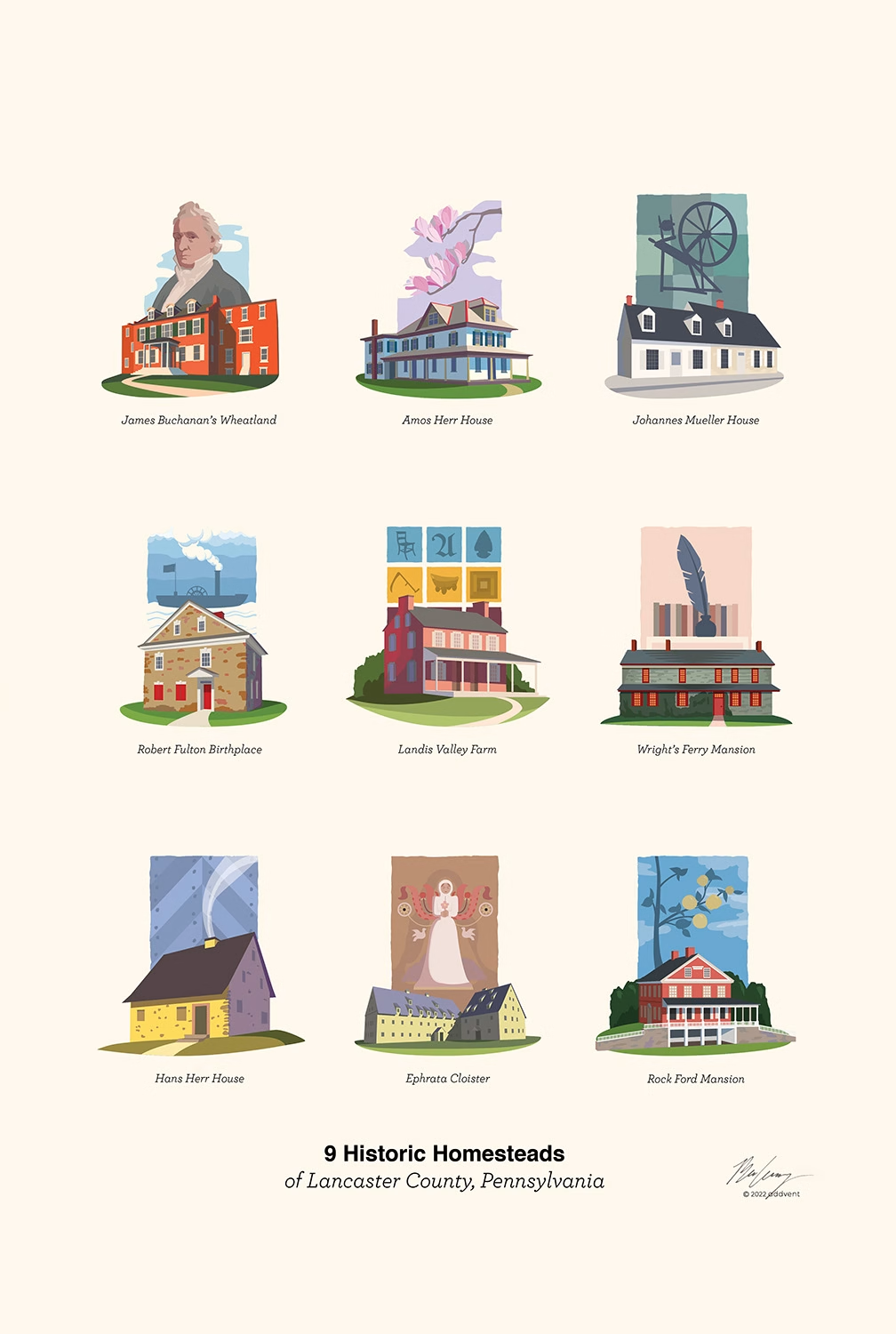
9 Historic Homesteads

13 Obelisks of Rome
12 Types
of Pizza

15 Types of Shellfish
