05.08.2026
7 Belvederes
of Italy


The Colosseum is the largest amphitheater ever built, completed in 80 AD under Emperor Titus, and it could hold an estimated 50,000 to 80,000 spectators. For nearly four centuries it hosted gladiatorial contests, animal hunts, and dramatic public spectacles that shaped Roman identity. Today it is one of the most visited monuments in the world and remains the enduring symbol of ancient Rome. The Colosseum is a UNESCO World Heritage Site and still anchors the Roman Forum archaeological park.

Perched on a hillside in eastern Sicily, the ancient theater of Taormina was originally built by the Greeks in the third century BC and later expanded by the Romans. What sets it apart is its location: the stage frames a panoramic view of Mount Etna and the Ionian Sea, making it arguably the most dramatically sited ancient theater in the world. It seats approximately 5,400 people and remains one of Sicily’s most active venues, used for concerts, films, and festivals throughout the summer. The combination of Greek origins, Roman reconstruction, and living volcanic backdrop is singular.

Aosta, known as the “Rome of the Alps,” was founded as a Roman colony around 25 BC, and the Roman theater built there ranks among the best-preserved in northern Italy. Its most striking feature is the towering façade wall, which still stands to a height of roughly 22 meters, giving a vivid sense of the structure’s original grandeur. The theater could accommodate around 4,000 spectators and sits within a broader archaeological zone that includes a Roman arch, forum, and city walls. Aosta’s entire urban core is essentially a Roman city still visible beneath the modern one.

Built in the first or second century AD, the Roman Theatre of Trieste sits at the foot of the San Giusto hill, partially embedded in the medieval urban fabric that grew up around it over the centuries. It was only partially excavated in the twentieth century, and today its tiered seating and stage foundations are open to visitors. It seats up to 6,000 spectators. Trieste’s position on the northeastern edge of Italy, where Roman, Austro-Hungarian, and Slavic cultures converged, makes this site particularly layered in its history. The theater is still used for summer performances, continuing a tradition of public spectacle that began nearly two thousand years ago.
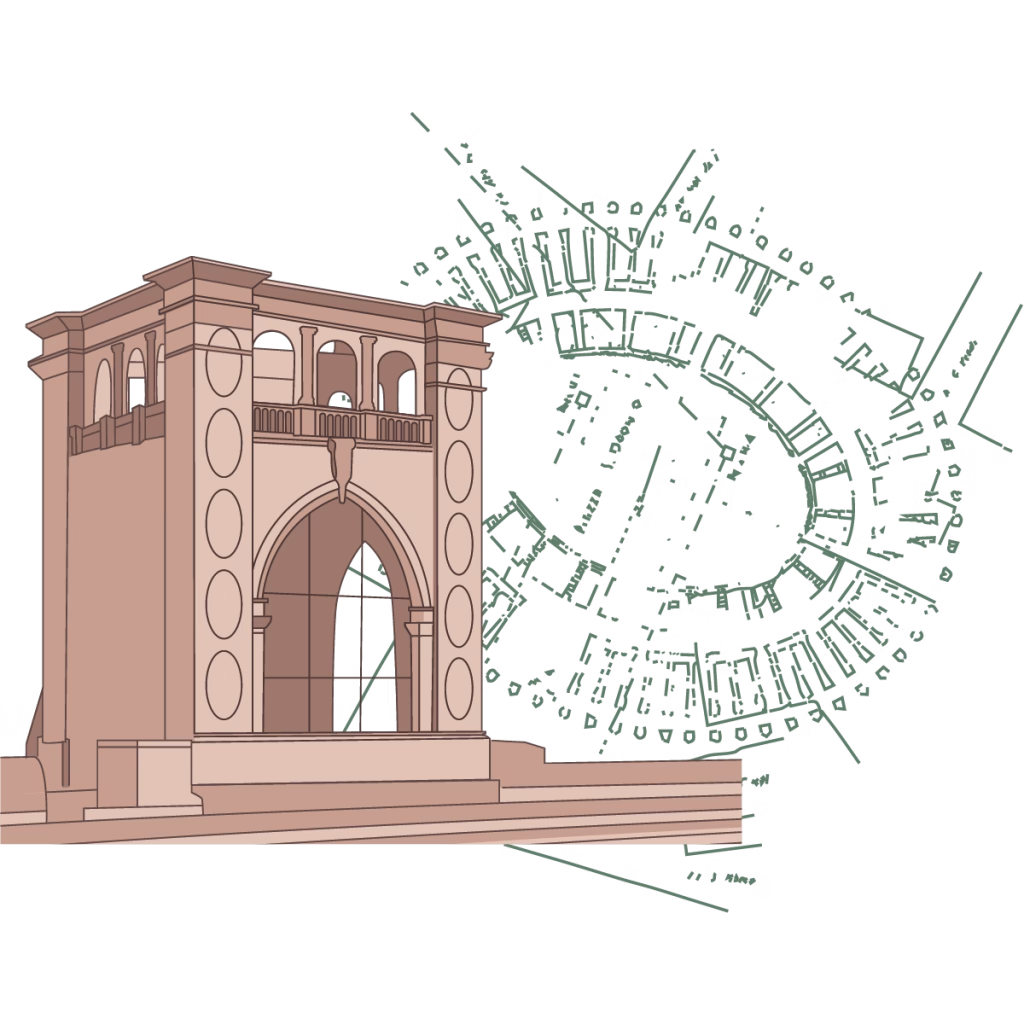
Discovered in the early twentieth century beneath the heart of Lecce’s baroque city center, this Roman amphitheater dates to the first or second century AD and once held up to 25,000 spectators. It sits in Piazza Sant’Oronzo, partially excavated and open to the street, so visitors encounter it simply by walking through the city. Much of the structure remains underground, but the visible section gives a clear sense of its original scale. Lecce’s amphitheater is a striking reminder that this elegant southern city has been a cultural hub far longer than its famous baroque architecture suggests.

The Campanian Amphitheater in Santa Maria Capua Vetere is the second largest Roman amphitheater ever built, surpassed in size only by the Colosseum. It dates to the first century AD and once rivaled Rome’s great arena in prestige — the city of Capua was one of the most important in the Roman world, and this amphitheater reflects that status. Beneath the arena floor, a remarkable network of underground vaulted corridors survives intact, where animals and gladiators were held before entering the arena. It was near ancient Capua that Spartacus and his fellow gladiators launched their famous revolt in 73 BC, a connection the site does not let visitors forget.

The amphitheater at Pompeii is the oldest surviving Roman amphitheater in the world, built around 70 BC — more than a century before the Colosseum. It held approximately 20,000 spectators and was used for gladiatorial games until the eruption of Vesuvius in 79 AD buried the city under volcanic ash. Because Pompeii was sealed so suddenly, the amphitheater has been preserved in extraordinary condition, offering one of the clearest windows into Roman public entertainment. It famously appeared on the cover of Pink Floyd’s 1972 live album Live at Pompeii, filmed on site.

Built around 30 AD, the Arena di Verona is one of the best-preserved Roman amphitheaters in the world and the third largest ever constructed. It seated approximately 30,000 people in its Roman heyday and still hosts thousands of visitors each summer for its famous open-air opera festival, which has been running since 1913. The outer ring was largely destroyed by a medieval earthquake, but the interior cavea remains remarkably intact. Few places on earth let you sit in two-thousand-year-old stone seats and watch a live performance under the stars.
This collection of illustrations captures the enduring geometry and grandeur of Italy’s ancient performance spaces — arenas and theaters that have outlasted empires and still draw crowds today. Gaviraghi’s clean lines and vibrant palette give each site a contemporary energy while honoring its history.
PLAN YOUR VISIT

READY TO EXPLORE?
If you’re the kind of person who wants to take the next step, to truly visit, experience, and work your way through a journey like this one, we’ve got you covered.
Visit all 8 ancient arenas of Italy, check each one off your list, and celebrate the adventure with a poster of your own.

RELATED TOPICS