30.06.2026
9 Cloud Formations


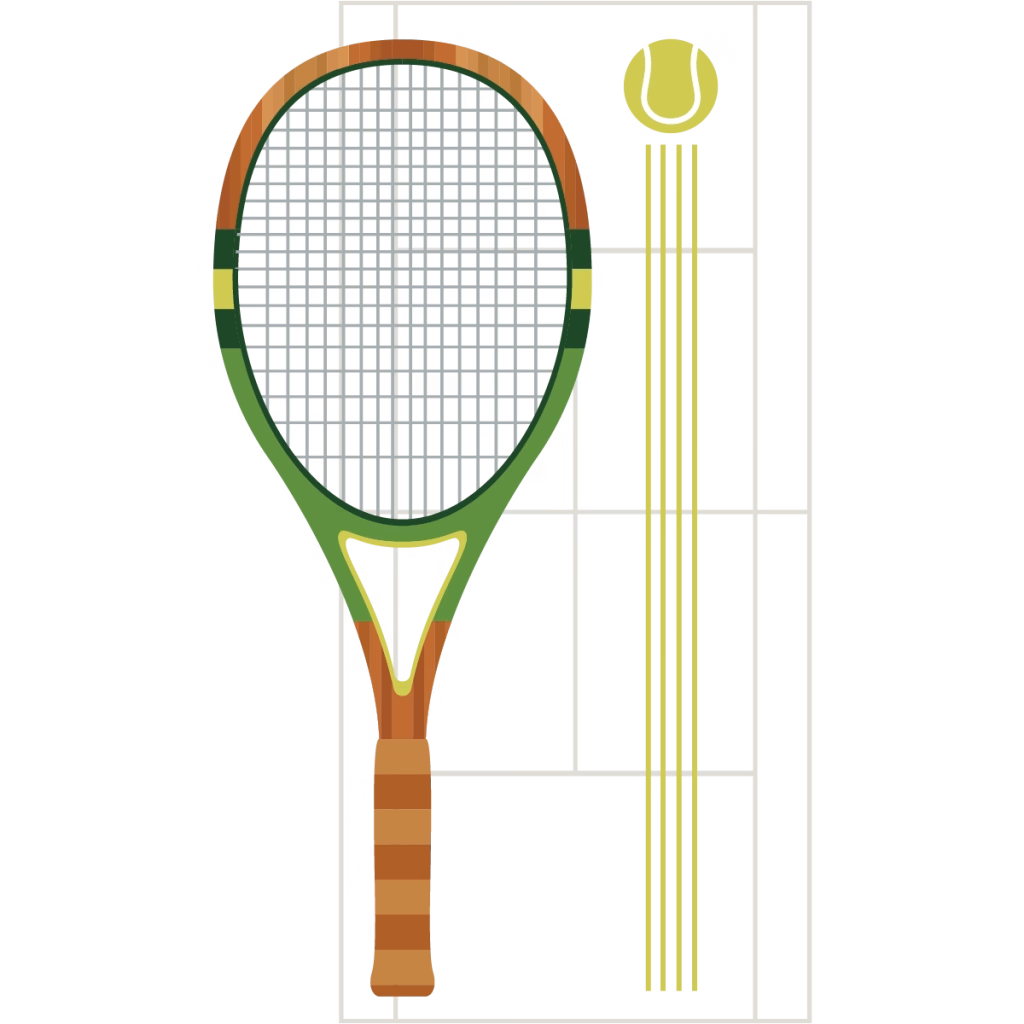
Tennis is one of the oldest and most widely recognized racket sports in the world, with roots tracing back to 12th-century France, where players batted a ball with the palm of the hand. The modern game as we know it today was formalized in England in 1873 by Major Walter Clopton Wingfield, who patented a version played on grass.
Today, the sport is governed by the International Tennis Federation (ITF) and is played competitively in over 200 countries. Its four Grand Slam tournaments, including Wimbledon and the US Open, are among the most watched sporting events globally.

Ping pong, also known as table tennis, began as an after-dinner parlor game among the upper classes of England in the 1880s, often played with improvised equipment including books as nets and rounded corks as balls. The sport grew rapidly in the 20th century and today is governed internationally by the International Table Tennis Federation (ITTF), which counts 226 member associations.
It has been an Olympic sport since 1988. At the elite level, the game is extraordinarily fast, with rallies exchanged at speeds that test the limits of human reaction time.

Fresco ball, also known as matkot or beach paddleball, is a cooperative racket game typically played on the beach using solid wooden paddles and a rubber ball with no net required. The game is deeply associated with Israeli beach culture, where it has been a summer fixture for decades, and the term “matkot” comes from the Hebrew word for racket.
Players work together to keep a rally going as long as possible rather than competing for points, giving it a communal, low-barrier appeal. While informal in its traditional form, organized competition has grown in recent years through international matkot tournaments.

Padel was invented in Mexico in 1969 by businessman Enrique Corcuera, who built the first court at his home in Acapulco by enclosing a smaller tennis area with walls to keep the ball in play. The sport spread through Spain and Latin America and has since become one of the fastest-growing sports in Europe, with Spain alone boasting over 4 million players and more than 20,000 courts, according to the International Padel Federation.
Played in doubles on an enclosed glass-and-metal court, padel allows players to use the walls as part of the game, creating a dynamic and social style of play.

Pickleball is the fastest-growing sport in the United States, with the Sports & Fitness Industry Association (SFIA) reporting over 36 million players in the US alone as of recent years. It was invented in 1965 on Bainbridge Island, Washington, by three fathers looking to entertain their bored kids using a badminton court, ping pong paddles, and a wiffle ball.
The sport combines elements of tennis, badminton, and table tennis, and is particularly popular among older adults for its lower physical demand, though competitive play at the professional level is anything but leisurely.

Pop tennis, formerly known as paddle tennis, is a scaled-down version of tennis played on a shorter court with a depressurized ball and a solid, stringless paddle. It originated in the United States in 1898, when Frank Beal invented it for children in New York City parks, and it has been played on American courts ever since.
The sport rebranded to pop tennis in 2015 to attract a broader audience and modernize its image, according to Pop Tennis. Its shorter court and simplified rules make it accessible to beginners and older players, while still providing the competitive depth that appeals to experienced athletes.

Racquetball was invented in 1950 by Joe Sobek, a professional tennis and squash player from Greenwich, Connecticut, who wanted a fast-paced indoor sport accessible to players of all skill levels. Sobek designed a strung paddle and adapted existing handball courts to create the game’s format.
According to the USA Racquetball Association, the sport peaked in popularity in the United States during the 1970s and 1980s and remains a staple of athletic clubs and recreation centers across the country. Its enclosed court and high-bounce rubber ball produce one of the most physically demanding games in the racket sport category.
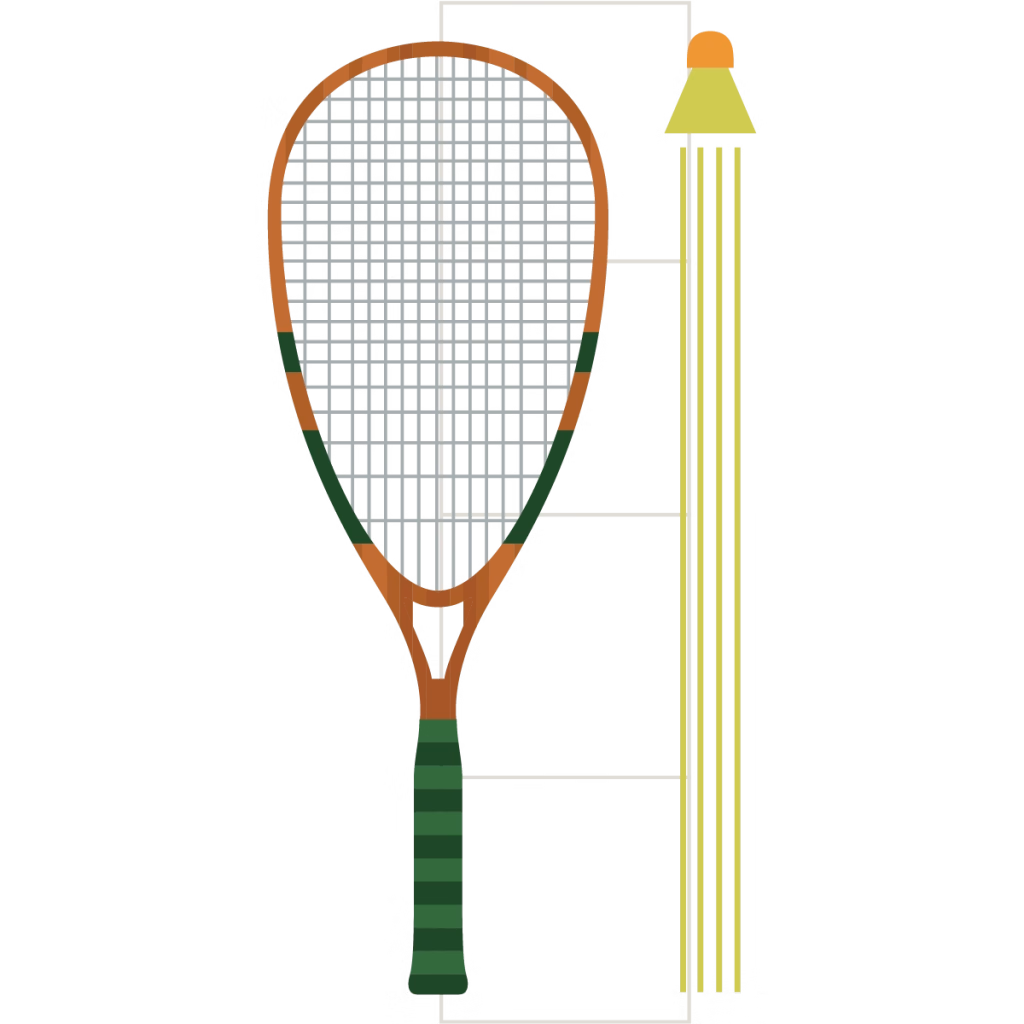
Speedminton, now officially rebranded as Crossminton, was created in 2001 by German entrepreneur Bill Brandes as a sport that could be played anywhere, without a net or boundary lines. Instead of a traditional shuttlecock, the game uses a “speeder,” a weighted projectile designed to fly in wind and at high altitudes.
It can be played indoors or outdoors, on any flat surface, making it uniquely adaptable. The sport has since grown into an international competitive game with its own world championships, attracting players who want the feel of badminton with greater flexibility in where and how they play.

Squash was invented around 1830 at Harrow School in London when students discovered that a punctured, “squashable” rubber ball made for a more challenging game in the school’s walled practice courts. The sport spread through British clubs and military posts throughout the 19th century and is now played in over 185 countries, per the World Squash Federation.
Unlike many racket sports, squash is played in an enclosed four-walled court, where players alternate striking the ball against the front wall, requiring exceptional fitness and court awareness.

Badminton is the world’s fastest racket sport, with the shuttlecock recorded at speeds exceeding 300 mph in professional play. The game developed in British India in the mid-1800s and was brought to England, where it was popularized at the Duke of Beaufort’s estate, Badminton House, lending the sport its name.
According to the Badminton World Federation, the sport has over 220 million regular players worldwide, making it one of the most-played racket sports on Earth. It became an Olympic sport in 1992.

Beach tennis combines elements of tennis and beach volleyball, played on a sand court with a depressurized tennis ball and a solid paddle. The sport originated in Italy in the 1970s and has grown into a globally organized game under the International Tennis Federation (ITF), which now governs international competition and hosts a world tour.
Unlike standard tennis, the ball is never allowed to bounce, giving the game a fast, rally-focused pace. The beach setting and accessible learning curve have helped it gain a wide recreational following across coastal communities worldwide.
This collection of illustrations captures the rackets, paddles, balls, and shuttles that define each of these games, from the polished wood of a frescobol bat to the perforated face of a pickleball paddle. The bright, playful palette is designed to celebrate the variety within a single family of sports and invite you to discover the ones you’ve never tried.

READY TO EXPLORE?
If you’re the kind of person who wants to do more than just watch, and instead wants to truly play, master, and celebrate an adventure like this one, we’ve got you covered. At Addvent, we create illustrated lists of places to visit, things to see, and things to do, commissioned as beautiful posters you can display as a reminder of what you’ve accomplished.
Pick up a paddle for all 11 racket sports, check each one off your list, and grab a poster to mark the journey.