07.10.2026
12 Coffee-Making
Methods



The Northern Lights, also known as aurora borealis, is the only entry on this list you cannot touch. The bright lights in the sky form when charged particles streaming from the Sun collide with gases in Earth’s upper atmosphere, funneled toward the poles by the planet’s magnetic field. According to the Royal Museums Greenwich, oxygen produces the signature green glow, while nitrogen lends the purples, blues, and pinks.
It earned its place as a pure natural phenomenon rather than a fixed location. While you can catch them in various places around the world, the top locations to view the Northern Lights are in Alaska, Scandinavia, and Iceland.

Paricutin is the youngest volcano on the list, and the only one whose entire life was watched from start to finish. On February 20, 1943, it burst from a cornfield owned by farmer Dionisio Pulido in Michoacán, Mexico. The eruption gave scientists their first chance to document a cinder cone’s full life cycle.
Over nine years it grew to 424 meters and buried two towns before going quiet for good.

Straddling the border of Zambia and Zimbabwe on the Zambezi River, Victoria Falls is neither the tallest nor the widest waterfall, but its combination of size gives it the largest single sheet of falling water on Earth. It measures about 108 meters tall and 1,708 meters wide. Locally it is called Mosi-oa-Tunya, “the smoke that thunders,” for the spray that can rise visibly from kilometers away.
The United Nations Educational, Scientific and Cultural Organization(UNESCO) listed it as a World Heritage Site in1989.

This massive river valley carved by the Colorado River in Arizona, stretches 277 miles long, reaches up to 18 miles wide, and runs about a mile deep. Visitors can explore it by riding the historic Grand Canyon Railway, taking a helicopter tour, hiking on its trails, or simply enjoying the views from the scenic overlooks.
The National Park Service notes that the river established its course roughly six million years ago, while the rock exposed at the bottom is close to two billion years old. Few places on Earth let you look this far back into geologic time at a single glance.
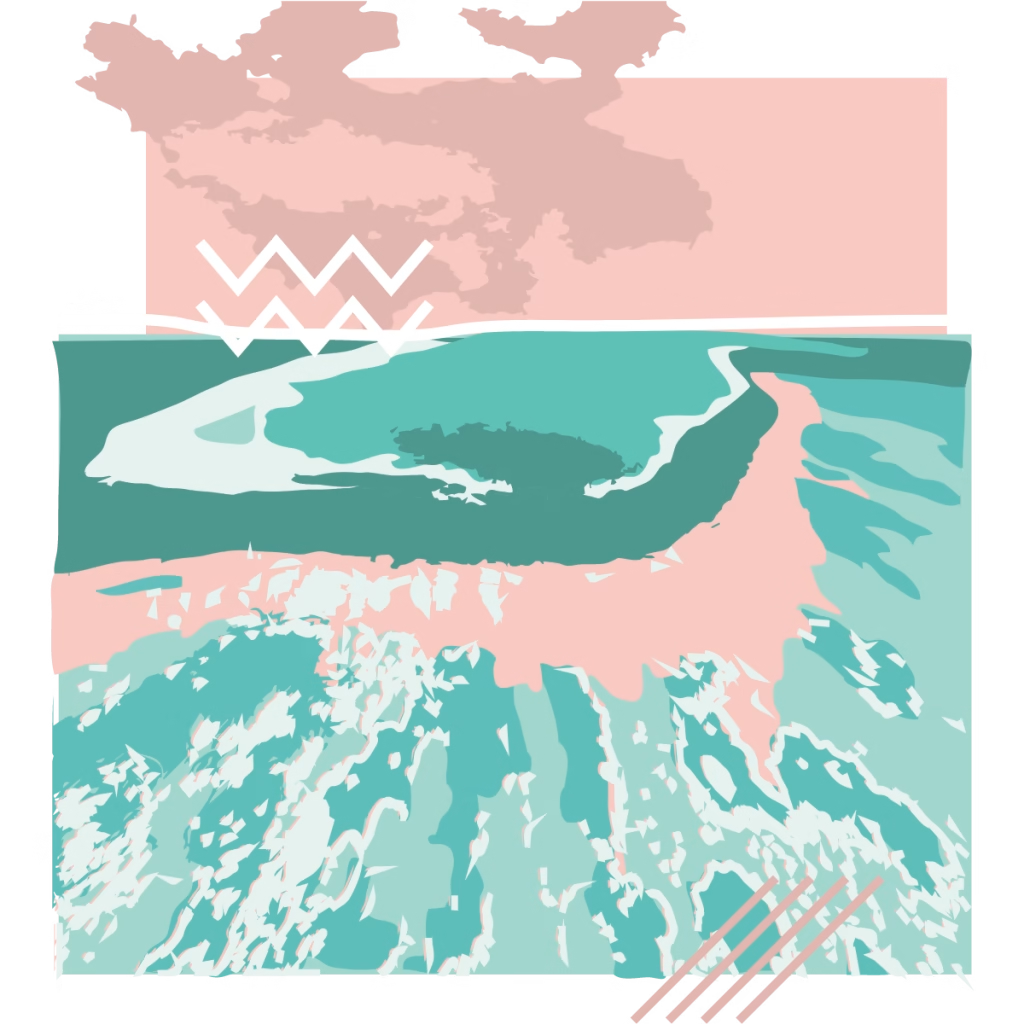
Off the coast of Queensland, Australia, the Great Barrier Reef is the largest living structure on the planet, and the only one visible from space. According to National Oceanic and Atmospheric Administration(NOAA), it stretches roughly 1,429 miles across an area of about 133,000 square miles. It is not one reef but a system of nearly 3,000 reefs and 900 islands, all built over millennia by tiny coral polyps. UNESCO designated it a World Heritage Site in 1981.

Also known as Guanabara Bay, the Harbor of Rio de Janeiro in Brazil is recognized as the largest bay in the world by volume of water. According to WorldAtlas, it spans about 412 square kilometers and holds more than 100 islands. Framed by granite peaks like Sugarloaf Mountain and overlooked by Christ the Redeemer, the bay was formed as a drowned river valley and first encountered by Portuguese explorers in 1502.
Take a boat tour through the bay, enjoy the views from a mountain summit via cable car, or soar above it all in a helicopter.
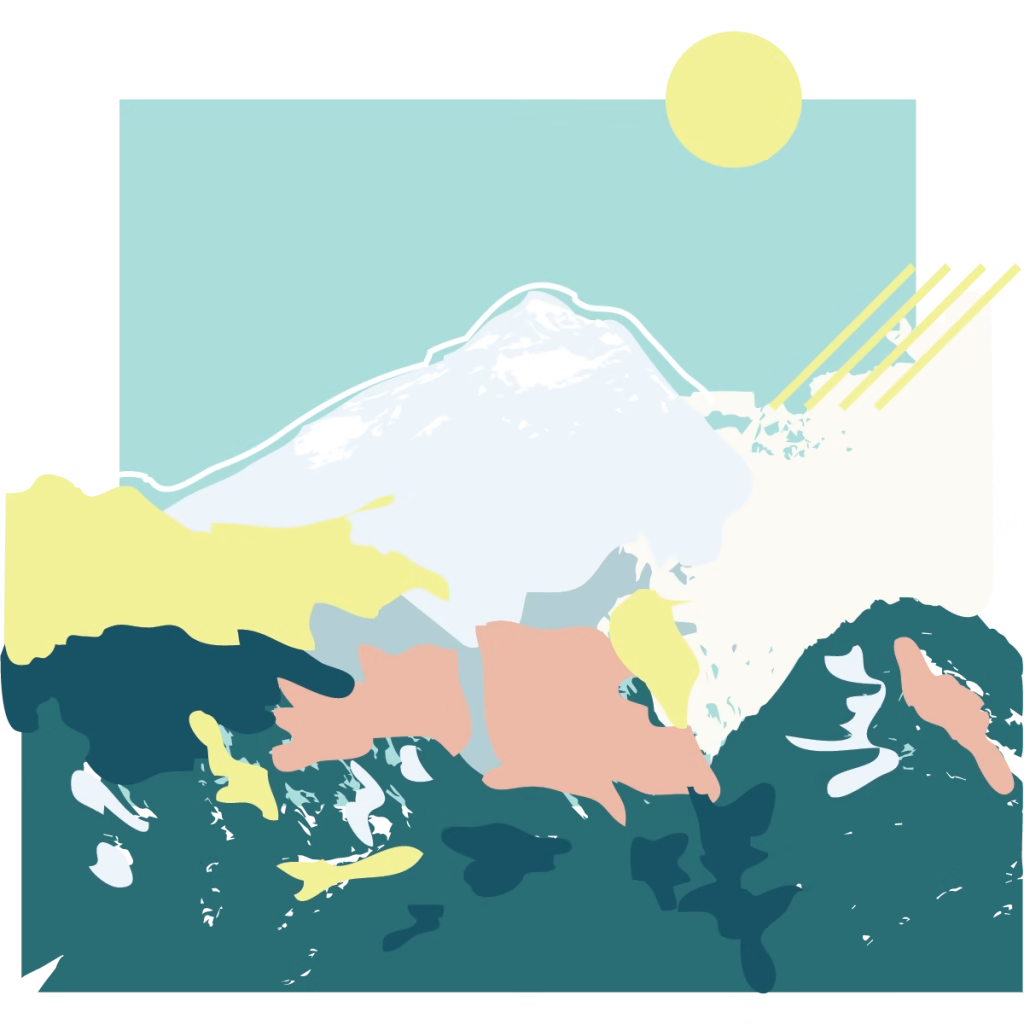
On the border of Nepal and the Tibet Autonomous Region of China, Mount Everest is the highest mountain on Earth. According to Britannica, its summit reaches 8,849 meters, a height confirmed by a joint Nepal-China survey in 2020. Edmund Hillary and Sherpa Tenzing Norgay made the first confirmed ascent on May 29, 1953, an achievement that reshaped high-altitude mountaineering and still draws climbers from around the world.
There are three main ways visitors experience Mount Everest: trekking to its base, taking a scenic flight around the mountain, or driving through the Tibetan side.
This collection of illustrations captures the scale and drama of each natural wonder, from the dancing light of the aurora to the towering snow of Everest. The artwork is designed to make each phenomenon feel as immense and alive as it is in person, turning a checklist into something worth hanging on a wall. Click on each illustration to view them up close.
Which of these would you cross the world to see? Could you experience all seven in one lifetime?

READY TO EXPLORE?
If you’re the kind of person who wants to do more than just read about the wonders of the world, and instead wants to truly experience, witness, and celebrate them, we’ve got you covered.
See all seven wonders for yourself, check each one off your list, and mark the journey with a poster of your own.