07.10.2026
12 Coffee-Making
Methods



Gustave Eiffel’s iron tower served as the entrance arch to the 1889 Exposition Universelle, held to mark the centennial of the French Revolution. According to ArchDaily, it was built as a temporary installation and faced fierce protest from Parisian artists who called it a monstrosity. Its survival owes much to its later usefulness as a radio transmission tower. Today it is among the most recognizable structures ever built.

The original Ferris Wheel debuted at Chicago’s 1893 World’s Columbian Exposition as America’s answer to the Eiffel Tower. According to the Navy Pier, the wheel was 264 feet tall and illuminated by 2,500 Edison incandescent lights.
Since then, there have been 2 more versions located on the Navy Pier. Today, you can view the newest version built in 2016 known as the Centennial Wheel, soaring 196 feet into the sky with enclosed, climate-controlled gondolas.
600 E Grand Ave, Chicago, IL 60611

Moshe Safdie’s Habitat 67 was one of the highlights of Montreal’s Expo 67 (April-October of 1967), and it began as his master’s thesis at McGill University. According to Tourisme Montréal, the complex stacks hundreds of prefabricated concrete modules to give dense urban housing the light, air, and private terraces of a suburban home. Remarkably, it is still a functioning residence and remains a touchstone of modular design.
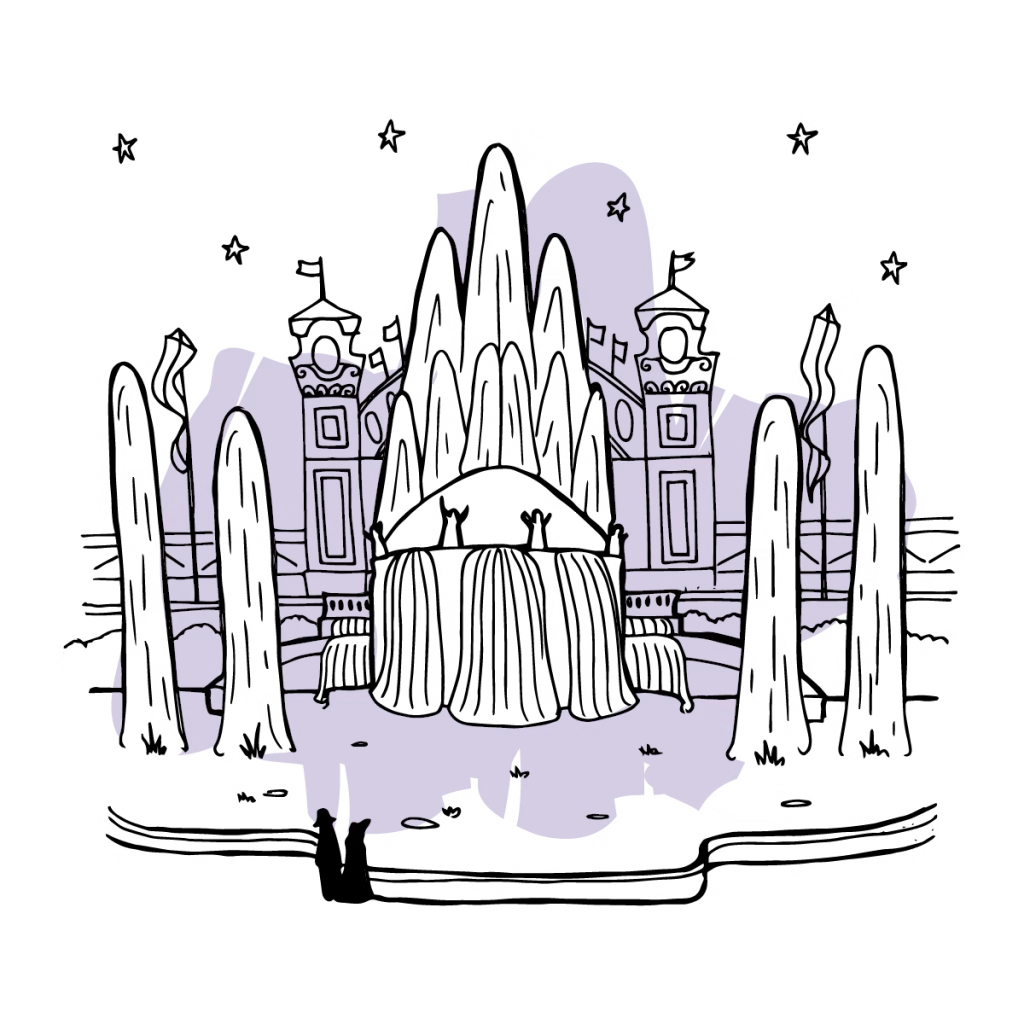
Inventor František Křižík built this electrically lit “singing” fountain for Prague’s 1891 Jubilee Exhibition, where it first lit up on May 24. According to Prague City Tourism, Křižík used 26 of his own arc lamps to illuminate jets of water against the night sky, a genuine technical marvel for its time. The version standing today is a faithful 1991 reconstruction at the Výstaviště exhibition grounds.

When the 1929 Barcelona International Exposition needed something spectacular, engineer Carles Buïgas proposed his Magic Fountain. According to the Barcelona City Council, more than 3,000 workers brought his ambitious design to life in under a year, with its first show on May 19, 1929. The fountain pioneered the art of choreographed light and water, and its evening displays still draw crowds today.
Pl. de Carles Buïgas, Sants-Montjuïc, 08038 Barcelona, Spain

Philip Johnson designed the New York State Pavilion for the 1964 New York World’s Fair, commissioned to be the tallest and largest structure on the grounds. According to the National Trust for Historic Preservation, its open-air “Tent of Tomorrow” held the world’s largest suspension roof over a giant terrazzo map of New York State. Now a striking ruin under restoration, it has appeared in films including Men in Black.

Bernard Maybeck designed the Palace of Fine Arts for San Francisco’s 1915 Panama-Pacific International Exposition, conceiving it as a romantic, overgrown Roman ruin. It proved so beloved that, as San Francisco Heritage notes, it was the one major fair structure spared from demolition. Built originally in plaster, it was reconstructed in permanent materials between 1964 and 1974 and remains a Marina District landmark.
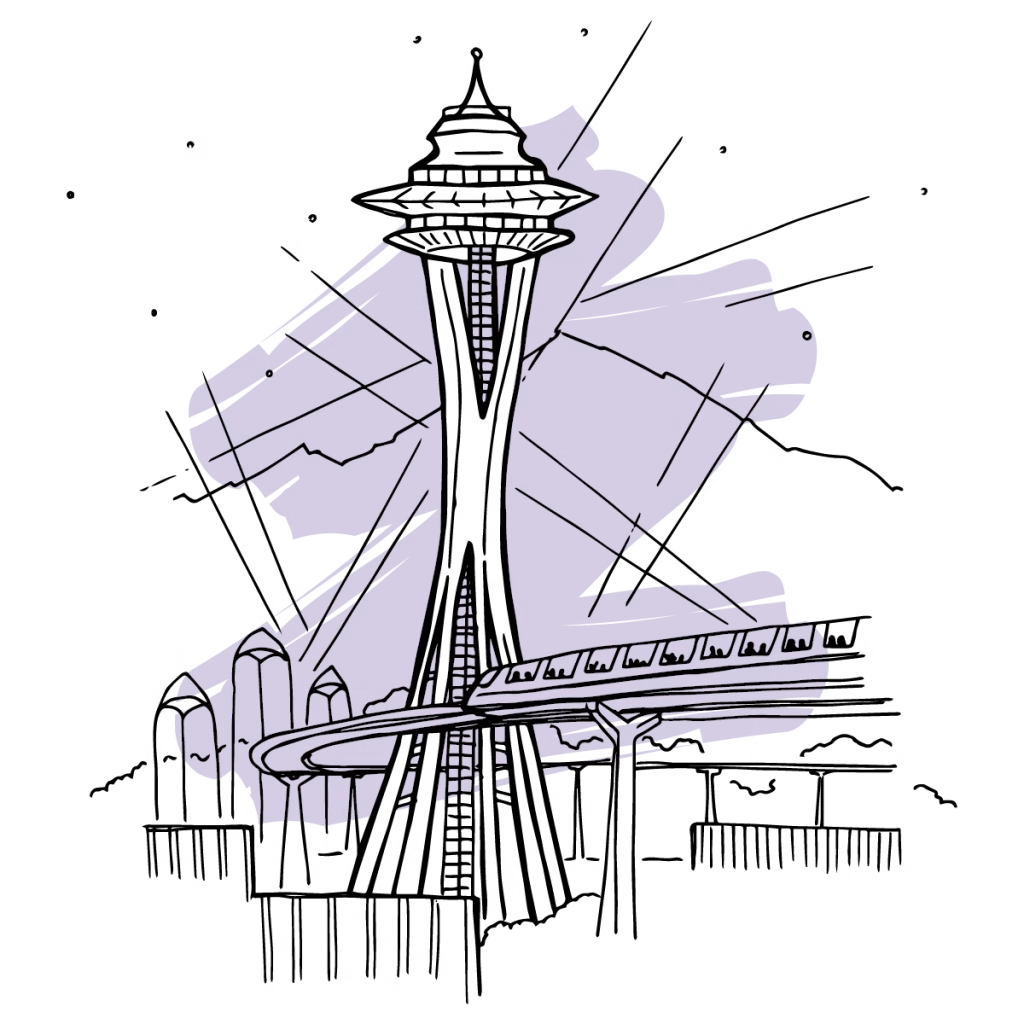
The Space Needle was the centerpiece of Seattle’s 1962 Century 21 Exposition, themed “Living in the Space Age.” According to HistoryLink, the 605-foot tower began as a doodle by fair commission chair Edward Carlson and was built by private investors in just over a year. Its revolving restaurant still turns near the top, and the Needle remains Seattle’s defining symbol.

Artist Taro Okamoto created the Tower of the Sun as the centerpiece of the Theme Pavilion at Osaka’s Expo ’70, themed “Progress and Harmony for Mankind.” According to the Tower of the Sun Museum, the 70-meter figure bears three faces: a golden mask for the future, a face for the present, and a black sun for the past. Originally meant to be temporary, its interior reopened to visitors in 2018.
太陽の塔地下 1階 1-1 Senribanpakukoen, Suita, Osaka 565-0826, Japan

The Unisphere was the symbol of the 1964 New York World’s Fair and its theme of “Peace Through Understanding.” A 12-story stainless-steel globe donated by U.S. Steel, it is recognized as the largest model of Earth ever built. According to Smithsonian Magazine, it stands on the very foundation that once held the Perisphere of the 1939 fair. It anchors Flushing Meadows-Corona Park to this day.

The Arc de Triomf was built as the main gateway to the 1888 Barcelona Universal Exposition. Unlike most triumphal arches, it commemorates no military victory. Designed by Josep Vilaseca in warm red brick and Neo-Mudéjar style, it was meant as a welcome, with sculptures showing Barcelona greeting the nations of the world. It still marks the entrance to Ciutadella Park, where the fairgrounds once stood.

Built for Brussels’ Expo 58, the Atomium represents a unit cell of an iron crystal magnified 165 billion times. According to the Atomium’s official site, engineer André Waterkeyn settled on the design after considering an upside-down Eiffel Tower, in keeping with the era’s faith in the atomic age. Its nine connected spheres rise 102 meters, and what began as a temporary pavilion became a permanent symbol of Brussels.
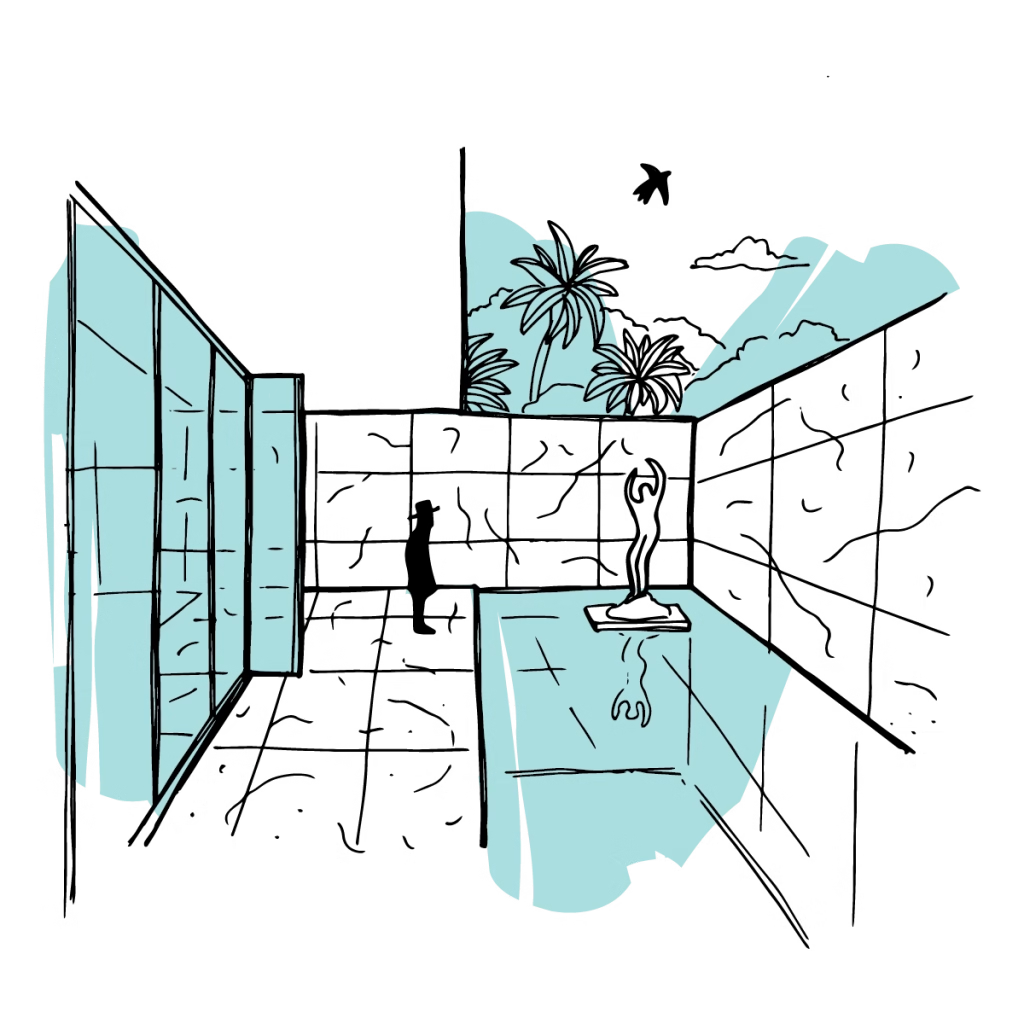
Ludwig Mies van der Rohe designed this German national pavilion, with Lilly Reich, for the 1929 Barcelona International Exposition. A landmark of modern architecture, it was built as a temporary structure and demolished in 1930. As the Fundació Mies van der Rohe records, it was reconstructed on its original site between 1983 and 1986. It also gave the world the enduring Barcelona chair.
Av. de Francesc Ferrer i Guàrdia, 7, Sants-Montjuïc, 08038 Barcelona, Spain

Buckminster Fuller designed this geodesic dome as the United States Pavilion for Expo 67, and it was the fair’s most popular attraction. According to Parc Jean-Drapeau, the Biosphere’s mission is to raise citizen awareness, action, and engagement on significant environmental issues in favor of the socio-ecological transition. Its acrylic skin was destroyed by fire in 1976, leaving the dramatic steel skeleton that now houses an environment museum in Parc Jean-Drapeau.

The China Art Palace was built as the China Pavilion for Shanghai’s Expo 2010, the tallest and most expensive pavilion at the fair. According to China Art Museum records, its inverted, crown-like form is inspired by the dougong, the interlocking bracket used in Chinese architecture for over two thousand years. Nicknamed the “Crown of the East,” it was permanently preserved and reopened in 2012 as the China Art Museum.
This collection of illustrations captures the daring shapes and engineering ambition of each World’s Fair landmark, from soaring iron lattices to gleaming spheres and modular concrete stacks. The art celebrates a recurring story: structures built to dazzle for a single season that proved too beautiful, too useful, or too beloved to disappear forever.
PLAN YOUR VISIT

READY TO EXPLORE?
If you’re the kind of person who wants to do more than just visit, and instead wants to truly experience, complete, and celebrate an adventure like this one, we’ve got you covered.
Track down all 15 World Fair landmarks, check each one off your list, and celebrate the journey with a poster of your own.

RELATED TOPICS